How Population, Lending and Rental Conditions Should Enter an Agency Forecast
Translate Australian population, housing lending and rental data into local assumptions for appraisals, transactions, PUM, fees, workload and capacity.
Read article
Insights
Practical perspectives at the intersection of finance, operations and business performance.
Translate Australian population, housing lending and rental data into local assumptions for appraisals, transactions, PUM, fees, workload and capacity.
Read articleCompare agency branches using contribution, conversion, revenue per FTE, PUM economics, market share and consistent overhead-not revenue alone.
Read articleAssess a rent-roll acquisition using retained AAMI, contribution, funding, staffing, integration, churn and downside scenarios-not the purchase multiple.
Read articleA useful agency dashboard connects sales funnel, agent contribution, PUM economics, capacity, cash and exceptions to management decisions.
Read articleA rent-roll valuation is not only AAMI multiplied by a market number. Fee quality, retention, concentration, arrears, staff and records affect risk and value.
Read articleInterest rates affect buyer capacity, vendor decisions, investor activity and agency cash. Translate RBA changes into local pipeline assumptions, not.
Read articleStress-test a real estate agency budget for lower transaction volume, weaker conversion, fee pressure, delayed settlements, churn and higher labour cost.
Read articleResidential agencies earn from transactions, not the value of unsold homes. Use housing turnover, market share, conversion and GCI to forecast revenue.
Read articleA 15% fall in residential transactions can reduce agency profit by much more because fixed costs remain. Model GCI, contribution, cash and PM resilience.
Read articleForecast agency cash by mapping contracts, settlement dates, commission receipts, agent payments, GST, wages and fixed costs into a 13-week view.
Read articleMeasure local real estate marketing through qualified opportunity, listings, contribution and geographic lift while recognising shared attribution and timing.
Read articleRaw lead cost can reward low-quality volume. Cost per qualified appraisal, listing and contribution gives real estate agencies a clearer marketing view.
Read articleA useful real estate agency budget starts with appraisals, listings, settlements, PUM, fees, labour and cash timing-not last year plus a percentage.
Read articleBuild a residential sales agency budget from appraisals, listings, conversion, GCI, commission splits, staffing and settlement cash timing.
Read articleMeasure real estate portal ROI through qualified vendor appraisals, listings, settlements and contribution-not impressions or enquiry volume alone.
Read articleLabour cost as a percentage of revenue can identify pressure, but sales volatility, commission mix and PM capacity require more detailed agency KPIs.
Read articleAdministrative support improves agent profitability only when released capacity becomes more appraisals, listings, settlements, service or control.
Read articleStaff turnover creates recruitment, lost productivity, service disruption, churn and pipeline risk. Measure its full cost in real estate agency margins.
Read articleDesign real estate agent commission splits around contribution, lead source, support and sustainable economics-not GCI alone or abrupt revenue cliffs.
Read articleUse capacity, pipeline, contribution, cash and service indicators to decide when a real estate agency should hire its next employee.
Read articleSmall property-management fee discounts compound across annual rent, PUM and years of service. Measure the effect on contribution and rent-roll income.
Read articleA small sales-commission discount can create a large contribution loss. Calculate the GCI and additional settlements needed to recover the margin.
Read articleCompare fixed-fee and percentage real estate commission models using expected GCI, conversion, workload, sale-price risk and contribution-not slogans.
Read articleCalculate property-management client acquisition cost using BDM, marketing, referral and onboarding costs, then compare it with contribution and retention.
Read articleLandlord churn reduces recurring revenue, wastes acquisition cost and can weaken rent-roll value. Measure PUM and AAMI lost, reasons and retention economics.
Read articleRent-roll growth does not automatically improve property-management profitability. Measure contribution per PUM, staffing steps, fees and churn.
Read articlePUM per property manager can support capacity planning, but pushing the ratio alone can weaken service, retention, staff stability and rent-roll value.
Read articleProperty-management capacity depends on complexity, support and service quality-not one door count. Use workload and financial signals to time the next hire.
Read articleRevenue per PUM helps explain rent-roll economics, but contribution per PUM shows what the agency keeps after direct property-management costs.
Read articleTurn appraisals, listings and contracts into a weighted GCI pipeline that improves real estate agency revenue and cash-flow forecasting.
Read articleGCI measures production, not complete agent performance. Learn how contribution, conversion, lead source and support costs improve real estate agent KPIs.
Read articleAppraisal-to-listing conversion is a key real estate agency KPI. Learn how to define it, segment it and use it for coaching, pricing and forecasting.
Read articleUse real estate sales funnel KPIs to distinguish weak lead volume from poor conversion at appraisal, listing, buyer and settlement stages.
Read articleCalculate real estate agent profitability using net commission, remuneration, support and lead costs-then interpret the result with pipeline and role context.
Read articleListing volume does not pay agency overhead until it converts. Use listing-to-sale conversion, cohort analysis and buyer activity to diagnose weak.
Read articleUnderstand the different economics of residential sales and property management, and why combined agencies need separate KPIs, budgets and margins.
Read articleReal estate agency margin rarely disappears in one dramatic event. Learn how fee discounts, labour, commissions, portals and churn create cumulative profit.
Read articleGCI is an important real estate sales measure, but it is not profit. Follow the commission waterfall from settlement revenue to agent contribution and agency.
Read articleHigher house prices can coincide with weaker agency profit. See why transaction volumes, listings, conversion and costs matter more than headlines alone.
Read articleLearn why revenue growth does not always improve Australian real estate agency profitability, and which margins and KPIs reveal the real result.
Read article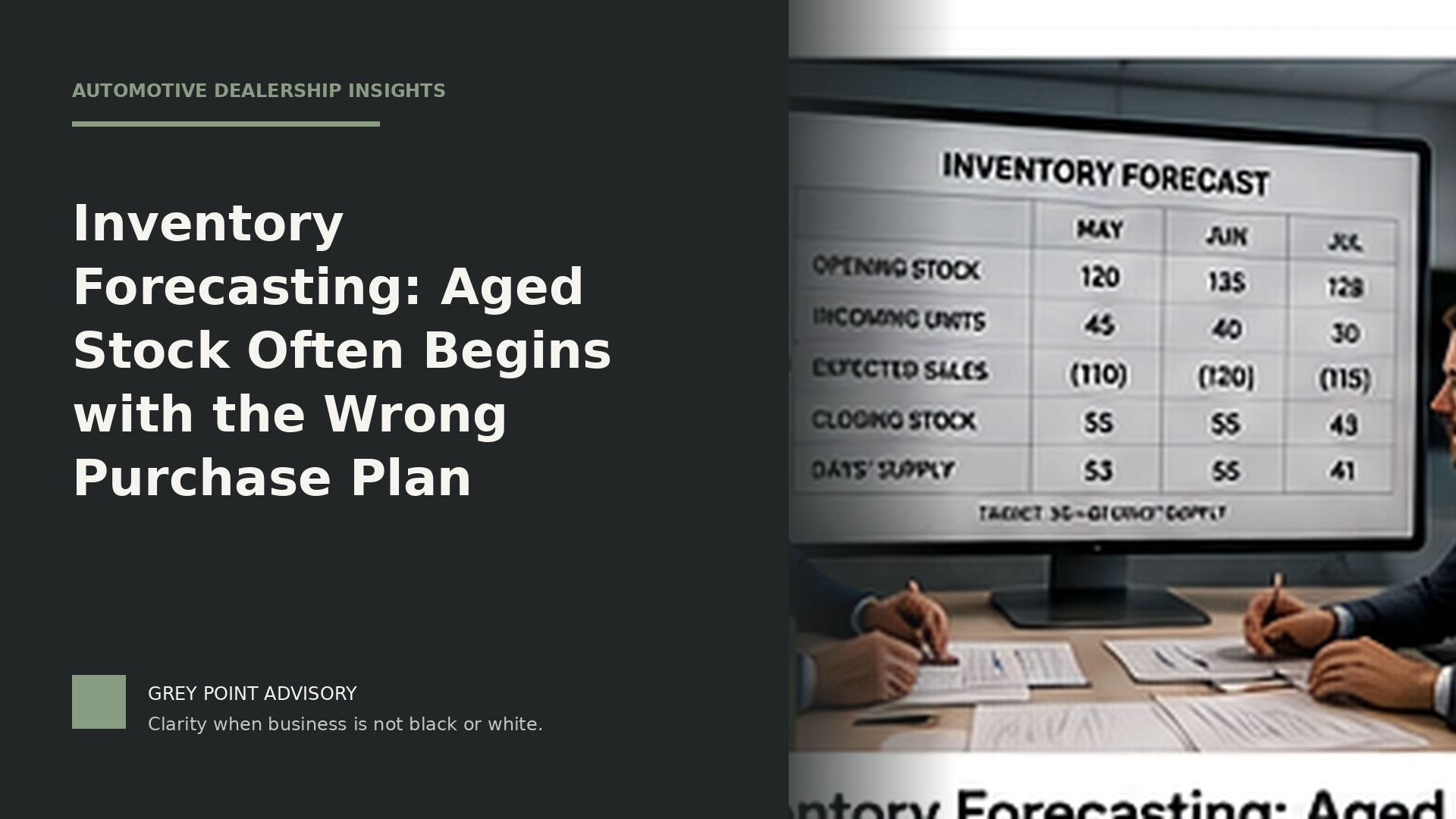
Aged stock is often treated as a sales problem because that is where it becomes visible. The vehicle has been sitting for 90 days, the enquiry has slowed and management starts discussing discount. But the economic mistake may have occurred months earlier, when the dealership ordered, accepted or appraised more stock than the market could absorb. By the time a vehicle reaches the aged-stock meeting, purchasing has already had a long head start. Good inventory management therefore begins with...
Read article
A used-car appraisal can be wrong on day one and still look acceptable for weeks. The outgoing deal is delivered, the customer is happy and the trade sits in stock with a respectable-looking gross target. The error becomes visible later: reconditioning exceeds estimate, enquiries are weak, price reductions begin, floorplan accumulates and the vehicle eventually wholesales below carrying value. By then the loss appears to belong to used cars, even though the economic mistake may have occurred...
Read article
A vehicle does not need to be sold before the market can tell the dealership that its carrying value is too high. That is the practical importance of net realisable value. The cost card records what the dealership invested in the vehicle. NRV asks a different question: what net amount does the dealership now expect to realise from selling it in the ordinary course of business? When those numbers diverge, the accounting should not wait for the eventual loss to become unavoidable. NRV is not...
Read article
A dealership can report an acceptable gross margin and still feel unexpected cash pressure. One reason is that inventory funding does not always behave like a simple interest-only facility. Depending on the floorplan agreement, ageing stock can trigger principal reductions, curtailments or other cash requirements. The accounting result may not immediately look worse, but the bank account does. That makes curtailment risk a working-capital issue long before it becomes a profit-and-loss issue....
Read article
A customer makes an offer and the first question is often: “How much are we losing?” That sounds financially disciplined, but it can be the wrong question. The dealership may be comparing the offer with historical cost, original gross expectation or a target that was set when the vehicle entered stock. None of those numbers automatically tells management the minimum price it should accept today. The relevant boundary is the value of the best realistic alternative from this point forward....
Read article
A dealership can report a healthy overall days’ supply and still have an inventory problem hiding inside it. Aggregate measures are useful because they show whether the total stock book is broadly aligned with sales velocity. But averages can conceal concentration. Too much capital can be tied to one model, one variant, one fuel type, one colour, one age bucket or one acquisition source while the total dealership number still looks comfortable. Average stock health can hide portfolio risk...
Read article
A demonstrator can be one of the most useful vehicles in a dealership and one of the easiest to mismanage. It supports test drives, keeps a model available for customers to experience and may help the dealership meet operational or franchise requirements. But once registered and placed into demonstrator use, the vehicle begins accumulating more than kilometres. It accumulates age, registration exposure, condition risk, funding cost and a narrowing retail window. That is why a demonstrator...
Read article
A price change on a new electric vehicle can affect much more than the cars still sitting at the distributor. It can reset customer expectations across demonstrators, near-new vehicles and used stock in a matter of days. The accounting cost of those vehicles does not move when the manufacturer changes its recommended price or introduces a stronger campaign. The market can. That gap between recorded cost and current customer reference price is where EV inventory risk becomes a dealership...
Read article
Most aged-stock reports are good at telling management what it already knows: which vehicles are old. A list of VINs, days in stock and book values can identify the problem, but it rarely explains what to do next. A useful dashboard should connect four questions: What is the vehicle worth now? Is the market engaging with it? What does another period of holding cost? What is the best available exit? Without those answers, an ageing report is a list, not a decision tool. Start with the stock...
Read article
A vehicle can sit quietly on a dealership floor while its economics change every day. The sticker price may be unchanged. The cost card may be unchanged. Yet the value of continuing to hold that vehicle can deteriorate through funding cost, market movement, ageing, advertising, presentation costs and the opportunity cost of capital tied up in stock that is not converting. That is why “90 days in stock” should not be treated as an age label. It should be treated as a financial trigger. Age is...
Read articleA question worth exploring?